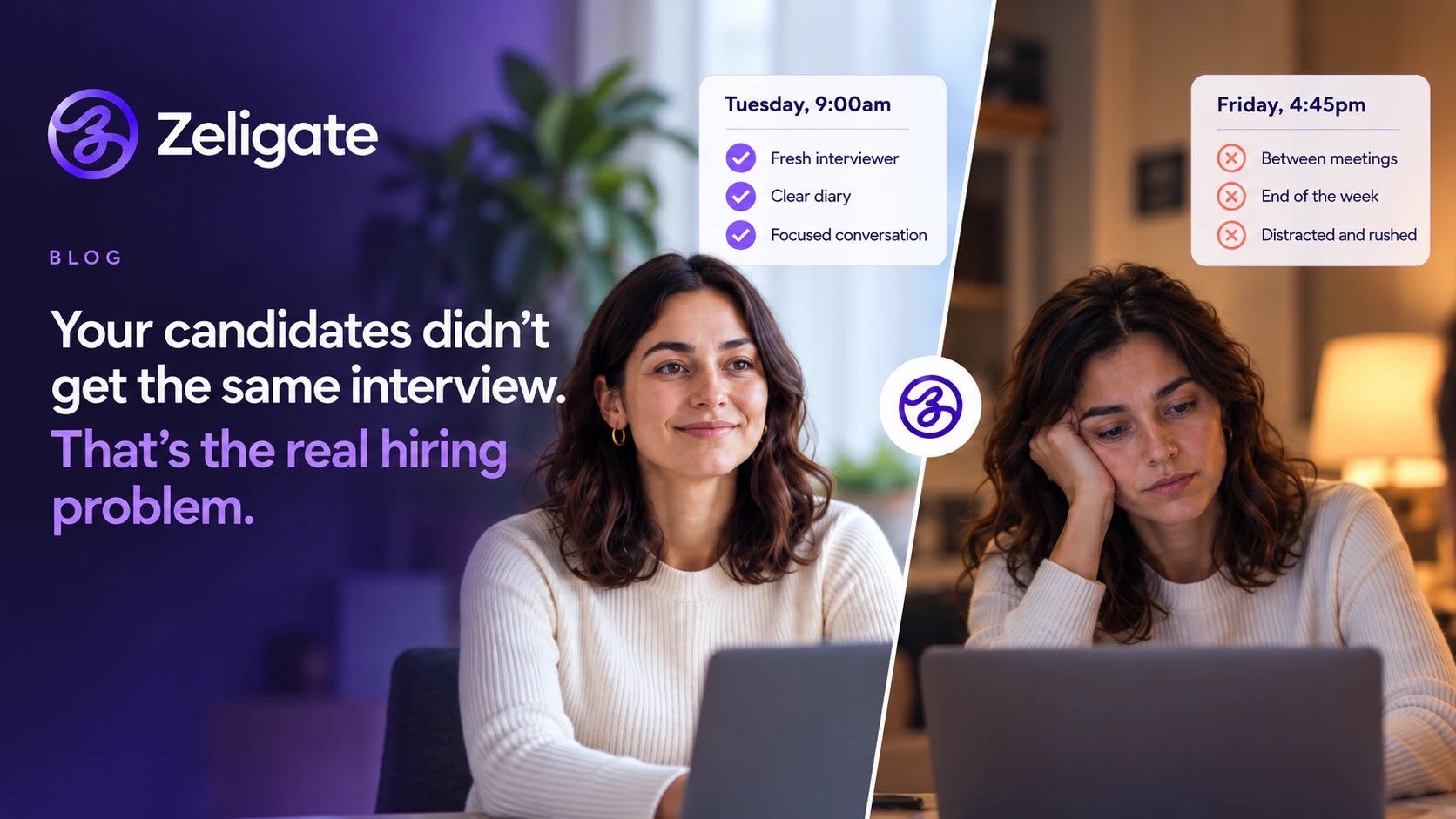
Two candidates apply for the same role.
One is interviewed at 9am on a Tuesday by a hiring manager who is fresh and has a clear diary. The other is interviewed at 4:45pm on a Friday, between a budget meeting and a school pickup.
They are not having the same interview. On the scorecard, they’ll be compared as if they were.
Most companies think their hiring problem is finding good candidates. A lot of the time, the problem is that they can’t compare the ones they’ve found. Here’s why, and what to do about it.
The interviewer is a variable
We talk about candidate quality as if it’s the only thing being measured. But every interview measures two things at once: the candidate and the person asking the questions.
Interviewers drift in ways they rarely notice:
- The questions change. Candidate one gets a deep dive on stakeholder management because the conversation went there. Candidate two never gets asked about it. Both are scored on “stakeholder management” anyway.
- Rapport does the scoring. When a candidate shares your alma mater, your sense of humour or your football team, the interview feels great. That feeling gets recorded as “strong communicator.”
- Memory edits the record. By the fourth interview of the week, the first one is a blur. Decisions get made on impressions, and impressions favour whoever was most recent or most vivid.
- The first five minutes decide the next fifty. Once you form a view, you spend the rest of the conversation looking for evidence that confirms it. You’ll ask easier questions of the people you like and harder ones of the people you don’t.
None of this makes anyone a bad interviewer. It makes them human. But it means two candidates with identical ability can walk out with different outcomes, and the difference has nothing to do with the job.
The research points the same way. In a landmark 1998 review of 85 years of selection research, Schmidt and Hunter compared 19 methods for predicting job performance. Structured interviews scored .51 on predictive validity. Unstructured interviews scored .38. On that scale, 0 means no predictive power and 1 means a perfect prediction.
The main difference between the two is structure: the same job-relevant questions for every candidate, scored the same way.
Why gut feel survives anyway
If unstructured interviewing is that noisy, why does nearly every experienced manager swear by their instincts?
Because the feedback loop is broken. You hire the person you liked. They do well, and your instinct looks right. The ones you rejected go elsewhere, and you never find out how they would have performed. You only ever see the half of the experiment that confirms you.
Add the fact that interviews feel like skilled work, because you’re reading body language, probing, following threads. Feeling skilled and being accurate are different things, and only one of them shows up in your hiring results.
What consistent actually looks like
The fix is old and unglamorous. Structure the process so the candidate is the only thing that changes.
- Decide what the role needs before you meet anyone. Pick the four or five things that predict success in this job, and write down what good and poor answers look like. If you build the criteria after the interviews, you’ll build them around whoever impressed you.
- Ask every candidate the same core questions, in the same order. This is the step people resist, and it’s the one that matters most.
- Take notes during the conversation, not after. What the candidate said is evidence. How you felt about it is a different thing, and the notes should keep them apart. Your memory is the weakest record in the room.
- Score before you discuss. Once the loudest person in the debrief states a view, everyone else adjusts toward it. Collect independent scores first, then argue.
“But the best interviews feel like conversations”
They do, and structure doesn’t kill that. The usual objection is that scripts make interviews robotic, and a badly run script does.
The answer is to structure the spine and leave the follow-ups free. Every candidate gets the same core questions. What you ask next, to understand their answer properly, is where your curiosity and experience belong. You get comparability where it matters and humanity where it helps.
Where AI belongs in this, and where it doesn’t
Consistency is the one thing software is genuinely better at than people. It doesn’t get tired at 4:45pm, doesn’t warm to a shared alma mater and doesn’t forget the first candidate by the fourth. It asks the same core questions every time.
The candidate’s side of the clock matters too. Zeli’s conversation happens when the candidate chooses, so nobody is interviewed at their worst hour because that was the slot left in someone else’s diary.
It also keeps the full record. Every question and answer is captured and written up in the candidate’s own words. So when someone asks what a candidate said about handling conflict, you can read the answer instead of reconstructing it from a note that says “good, bit vague.” The debrief changes when everyone can check a claim against the source.
Who gets the conversation is your call. Some employers have Zeli talk to every applicant, so nobody is dropped on a ten-second CV scan. Others use it for shortlisted candidates only. Either way, everyone who takes part is asked the same things and knows up front what’s being assessed.
Then the human takes over with a head start. By the time a hiring manager meets someone, they already have the transcript and a clear view of what’s still unanswered. The conversation becomes follow-up instead of a repeat of the basics.
But the limits matter as much as the strengths. A consistent process can be consistently wrong, so any AI used in screening has to be validated against real job outcomes and checked for bias, and you should ask any vendor, us included, to show you how. And the decision stays with people. Zeli’s role is to make the evidence cleaner, not to make the call.
The takeaway
Next time you finish an interview and feel certain, ask what you’re certain about. Was it something the candidate demonstrated, or something you felt?
If you’d like to see how Zeli runs a consistent conversation, whether for every applicant or just your shortlist, book a demo with Zeligate.
Sources
About Sam Naidoo
Sam co-founded Zeligate with Denver Naidoo in 2023. Sam writes about the company’s work on AI and hiring.
More from Sam Naidoo