Every few weeks someone asks me whether AI will replace recruiters. I think it’s the wrong question. The better one is which parts of hiring a person should be relieved of, and which parts we’d be mad to give away.
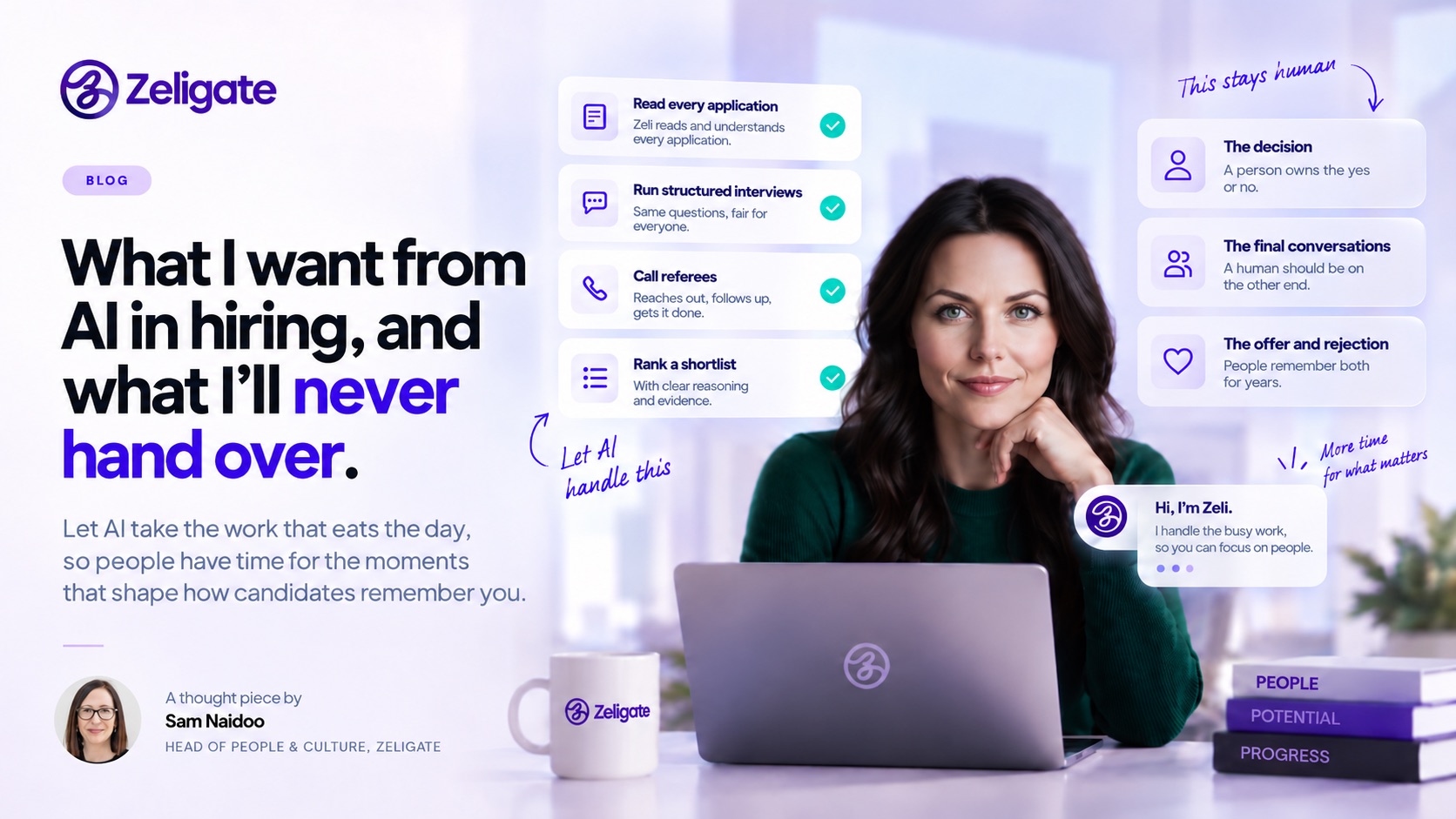
Start with what I’d hand over today, gladly. Chasing. Scheduling. The fourth email asking a referee to please call back. Sorting a few hundred applications to find the handful that deserve a proper look. Nobody went into People and Culture to do that work, and nobody makes better hires because they did it by hand at 9pm. It’s the work we built Zeli to take on. She reads every application, runs the same structured interview with every candidate, calls the referees and ranks a shortlist with her reasoning attached to each name.
The timing matters. Applicants per open role in Australia have nearly doubled since 2022, and more than a third of employers say AI-written CVs make it harder to judge people. Every CV is polished now. That’s exactly why the human parts of hiring count for more, not less.
Here’s what I won’t hand over
The decision. Someone has to own the yes or the no, and it has to be a person a candidate could in theory ask. Zeli gives me the shortlist and the evidence behind it. The call is still mine, and there’s an audit trail so I can explain it.
The conversation after the shortlist. Once we’ve narrowed it down, a human should be on the other end. That’s the moment a candidate decides whether they want to work with us, and I want us in the room for it.
The offer, and the rejection. People remember both for years. The rejection most of all.
For candidates, that should mean a quick answer and a real person when it counts. For me, it means hours back, and if none of them go into talking to people, I’ve missed the point.
About Sam Naidoo
Sam co-founded Zeligate with Denver Naidoo in 2023. Sam writes about the company’s work on AI and hiring.
More from Sam Naidoo